
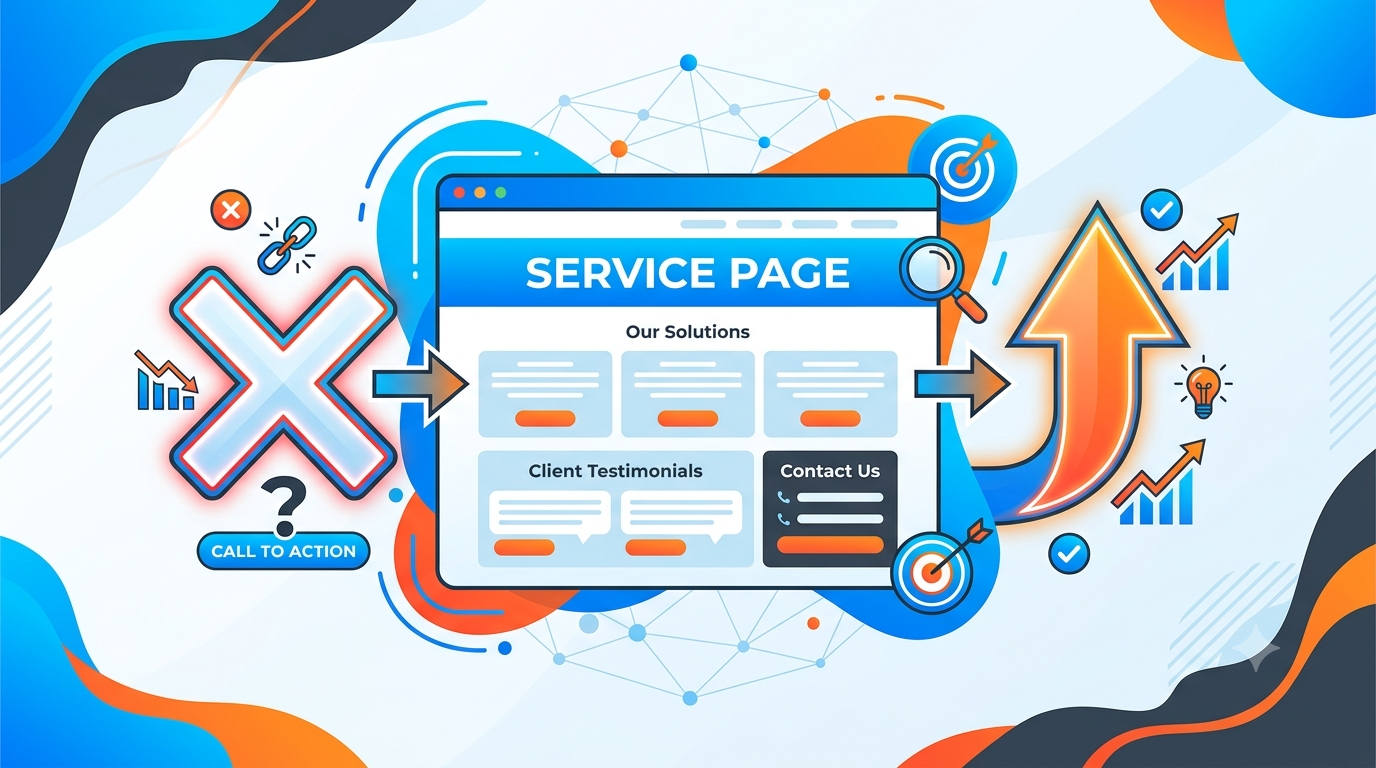
One service page trying to rank for five different services will rank for none of them. That’s the most common mistake we find when auditing websites. It quietly costs businesses real money every month, money a proper SEO strategy would otherwise capture.
Why This Mistake Is So Common
Most businesses build one services page because it feels efficient. One page, one job done, move to the next task. From a business owner’s point of view, that makes sense. From Google’s point of view, it doesn’t.
Google Rewards Depth, Not Breadth
Google does not reward pages trying to be everything at once. It rewards pages that cover one topic thoroughly. A page dedicated to a single service will consistently outrank a page that skims across five without going deep on any of them. Cram multiple services onto one page and you dilute every single one. You also undermine any SEO services you’ve already paid for.
What This Mistake Actually Costs You
Picture a plumbing business offering boiler repairs, power flushing, emergency callouts, and drain cleaning. Cramming all four onto one page means that page competes directly with specialists who built a dedicated page for each service.
The Specialists Win, Every Time
Their URLs contain the exact keyword someone searched for. Their content speaks directly to one problem, in detail. Their call to action matches the one thing the visitor came looking for. Your single, crowded page cannot compete with that kind of focus. No amount of good writing fixes that.
This isn’t a minor technical detail buried in an SEO checklist. It’s the difference between page one of Google and not appearing at all. And it’s exactly the kind of issue a good SEO company is trained to catch.
The Fix: One Page Per Service
The solution is straightforward. It just takes effort to put into place.
Step One: List Every Distinct Service
Write out every individual service you offer, no matter how closely related they seem to you.
Step Two: Build A Dedicated Page For Each One
Give each service its own page. A title tag written specifically for that service. A URL that matches it. Content that speaks only to that one problem and its solution.
Step Three: Write A Unique Call To Action For Each Page
Someone looking for an emergency callout wants a different message than someone researching routine power flushing. Match your call to action to their intent.
Step Four: Link Everything From A Central Hub
Keep your original services page in place, but turn it into a hub that links out to each individual service page. This helps visitors navigate. It helps Google understand your site’s structure too.
The Bottom Line
This is one of the most common issues our team finds when auditing websites. It’s also one of the easiest to fix once you know it’s there. If your service pages are underperforming, this is very likely why.
Handle the restructuring yourself or bring in an SEO company to manage it. Either way, don’t leave this mistake sitting on your site. Every month it stays unaddressed, you lose enquiries to competitors who got their page structure right first.
At Bemunchie Online, our SEO services include a full breakdown of exactly which service pages need splitting, in what order, and why. Get in touch and we’ll show you precisely where you’re losing ground and how to fix it.
FAQs
How many services need to be crammed onto one page before this becomes a problem?
Even two distinct services on one page can hold both back. Offer more than one clearly defined service and each one deserves its own page.
Will splitting my services page hurt my existing rankings while Google adjusts?
There can be a short adjustment period. The long-term gain in relevance and rankings far outweighs any brief dip. Done properly, with correct redirects and internal linking, the disruption is minimal.
Is this something I can do myself, or do I need an SEO company?
You can do it yourself if you’re comfortable with basic website editing and keyword research. Many businesses bring in an SEO company like Bemunchie Online to make sure the structure, keywords, and internal linking are handled correctly from the start.
Does this apply to product pages as well as service pages?
Yes. Same logic. A single page trying to sell five distinct products will rarely outperform five dedicated product pages, each optimised for its own audience and search intent.
